Thank you for writing to us. One of our executive will reach back to you through your submitted medium. In case there’s an urgency, feel free to connect over WhatsApp for faster response.
Prefer calling? Dial +918048890627 (International callers) or 8048890627 (Indian callers).
Suction Cups for Packaging Automation
Packaging lines are notorious for high cycle speeds and dusty environments. When selecting cups for this sector, consider:
Porosity Handling: Cardboard is naturally porous. To maintain a grip, you need high-flow vacuum generators or cups with specialized foam seals.
Food Safety: If the cup touches raw or packaged food, it must be FDA-compliant and often “detectable“ (impregnated with metal fragments) so it can be caught by X-ray scanners if a piece breaks off.
High-Speed Stability: In “delta“ style picking robots, the cup must resist lateral forces to prevent the product from swinging or dropping during rapid directional changes.
Prevent Condensation in Pneumatic Systems with PISCO EQJ Quick Exhaust Valve
Even when a high-quality air dryer is installed near the compressor or before the FRL unit, condensation can still occur inside pneumatic systems. This problem is commonly seen in high-speed automation applications using air grippers, mini cylinders, and short-stroke pneumatic actuators.
The main reason is adiabatic expansion.
When compressed air rapidly expands, the air temperature suddenly drops. In systems where the piping between the solenoid valve and actuator is long, and the cylinder stroke is very short, all the air inside the tube cannot exhaust completely during fast operation cycles. The remaining air experiences repeated pressure and temperature changes, creating mist and eventually water inside the tubing.
This issue is especially common in:
Air grippers
Pen cylinders
Short-stroke cylinders
High-speed pick-and-place systems
Compact automation machines
Problems Caused by Condensation
Water inside pneumatic lines can lead to:
Grease washout inside cylinders
Unstable actuator movement
Corrosion and internal damage
Reduced gripping accuracy
Increased machine downtime
Shorter actuator life
Industries such as electronics, semiconductor manufacturing, automotive automation, packaging, robotics, and CNC/SPM machines often face these challenges.
PISCO EQJ Quick Exhaust Valve Solution
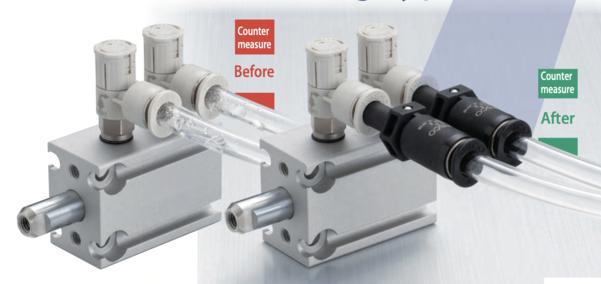
The PISCO EQJ Quick Exhaust Valve is designed to solve condensation problems directly at the
actuator side.
Instead of exhausting air only through the solenoid valve, the EQJ valve exhausts air close to the air gripper or cylinder. This minimizes adiabatic expansion inside long pneumatic tubing and helps prevent condensation.
Unique Socket-Type Design
A major advantage of the EQJ series is its compact socket-type structure. It can be directly connected to:
Pneumatic fittings
Speed controllers
Air grippers
Mini cylinders
Very few competitors offer this type of compact quick exhaust solution, making the EQJ series highly unique in the pneumatic automation market.
Key Benefits
Prevents condensation inside pneumatic tubes
Improves actuator life and reliability
Maintains smooth cylinder movement
Reduces maintenance and downtime
Easy retrofit installation
No need to redesign the pneumatic system
Cost-effective automation upgrade
Customers can simply install the EQJ valve into their current pneumatic setup without replacing cylinders or changing piping layouts.
Proven Industrial Performance
The EQJ series has already been successfully used in many automation applications across Asia. Nearly 1,000 pieces were supplied in Thailand over the last 1–2 years specifically for solving condensation problems in high-speed pneumatic systems.
Available Sizes
The EQJ Series is available in:
3 mm
4 mm
6 mm
These compact sizes are ideal for modern automation equipment and small pneumatic actuators.
Applications
The EQJ quick exhaust valve is widely used in:
Robotics
Pick-and-place automation
Packaging machinery
SMT and semiconductor equipment
Industrial automation systems
Compact pneumatic machinery
Why Choose PISCO Pneumatic Products
PISCO Official Website is globally recognized for compact, high-quality pneumatic automation products designed for advanced industrial applications.
The EQJ Quick Exhaust Valve is a simple but highly effective solution for preventing moisture problems and improving pneumatic system performance.
Key Products
Pneumatic condensation solution
Quick exhaust valve for air gripper
Prevent water in pneumatic cylinder
PISCO EQJ valve India
Pneumatic moisture prevention
Mini cylinder condensation solution
Pneumatic automation products India
High-speed cylinder exhaust valve
Air gripper water problem
Pneumatic reliability improvement
For industrial automation in India, the PISCO EQJ Quick Exhaust Valve is an effective, economical way to improve the reliability of pneumatic systems and extend actuator life.

 Chat with us