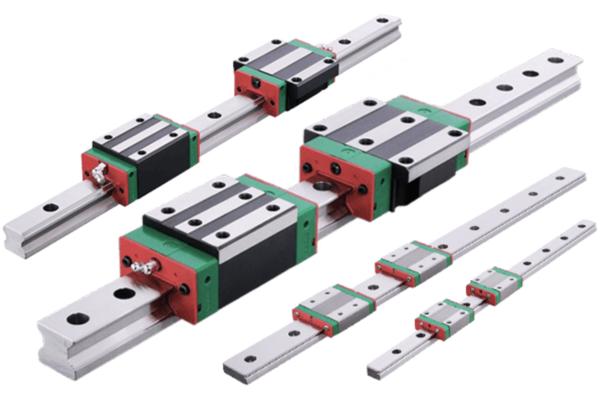
HIWIN Linear Guideways: The Ultimate Selection and Maintenance Guide (2026) In the world of precision automation, HIWIN linear guideways have become the industry standard for achieving high-positioning accuracy and smooth linear motion. Whether you are retrofitting a CNC machine or designing a high-speed semiconductor assembly line, choosing the right series is a balance between load capacity, space constraints, and environmental factors. 1. Understanding the Core Technology A HIWIN linear guideway consists of a profile rail and a bearing block (carriage). The magic happens within the block, where recirculating rolling elements (balls or rollers) minimize friction to a coefficient of roughly 1/50th of a traditional sliding guide. Why HIWIN? Equal Load Capacity: Most series (like the HG and EG) are designed to handle loads in radial, reverse-radial, and lateral directions equally. Self-Alignment: HIWIN’s circular-arc groove design can absorb small installation errors, ensuring smooth motion even if the mounting surface isn't perfectly flat. Interchangeability: High manufacturing standards allow you to replace blocks or rails independently while maintaining precision. 2. Choosing the Right Series: A Comparison Not all linear guides are created equal. Using an oversized rail wastes money and space, while an undersized one leads to premature “pitting“ or failure. Series Type Primary Feature Best For HG Ball Heavy load, high rigidity CNC machines, grinding, heavy-duty lathes. EG Ball Low profile, compact Packaging, high-speed automation, robotics. RG Roller Extreme rigidity Heavy cutting, high-precision milling. MG Ball Miniature, stainless steel Medical devices, semiconductor, 3D printers. WE Ball Wide rail, high moment Single-axis applications with high torque. Technical Insight: Balls vs. Rollers The HG series uses steel balls, providing a “point contact“ that excels in speed and lower friction. The RG series uses cylindrical rollers, creating a “line contact.“ This significantly increases the contact area, reducing elastic deformation and making it the “gold standard“ for heavy-duty industrial machining where vibration must be zero. 3. High-Tech Options: SynchMotion™ & Cover Strips For advanced 2026 applications, two specific HIWIN innovations are worth the investment: SynchMotion™ (QH/QE/QR Series): These blocks include a “ball separator“ between the rolling elements. This prevents ball-to-ball friction, leading to quieter operation, higher speeds, and longer lubrication intervals. Cover Strips (CG Series): Traditional rails have mounting holes that can collect dust. The CG series features a stainless steel cover strip that snaps over the rail, providing a completely smooth surface for the seals to glide over, drastically extending life in “dirty“ environments like woodworking. 4. Maintenance: The “100km Rule“ Most end-user failures are not due to load, but lack of lubrication. Lubrication Schedule Linear guides should be relubricated every 100km of travel or every 3 to 6 months, whichever comes first. If you are operating in a high-dust environment (e.g., carbon fiber routing), this interval should be halved. Tips for Longevity: Check the Wipers: If the rubber end-seals on your block look cracked or worn, replace them immediately. A $10 seal protects a $500 rail system. Grease Type: Use a lithium-soap-based grease (like HIWIN G05) for general applications. Avoid mixing different types of grease, as chemical incompatibility can cause the lubricant to harden. Initial Pre-greasing: New blocks often come with only a light coat of anti-rust oil. Always perform an initial lubrication before running the system under load. 5. Avoiding Common Installation Mistakes Expert experience shows that alignment is everything. The Master Rail: Always designate one rail as the “master“ and align it to a reference shoulder on your machine bed. The “subsidiary“ rail should then be aligned relative to the master. Torque Spec: Use a calibrated torque wrench. Over-tightening mounting bolts can slightly deform the rail, causing “binding“ and localized wear. Parallelism: For a dual-rail setup, parallelism should usually be within 0.01mm to 0.05mm (depending on the series and preload). Pro Tip: If your machine “shudders“ or makes a clicking sound at certain points, it’s likely a parallelism issue. Loosen the subsidiary rail bolts, run the carriage across the full stroke, and re-tighten. Conclusion HIWIN linear guideways offer a versatile, high-performance solution for almost any motion challenge. By matching the series (HG for power, EG for speed, RG for stiffness) to your specific needs and sticking to a rigorous lubrication schedule, you can ensure your machinery operates with micron-level precision for years.

Delhi
08048060901
+919880566644
 Chat with us
 Chat with us